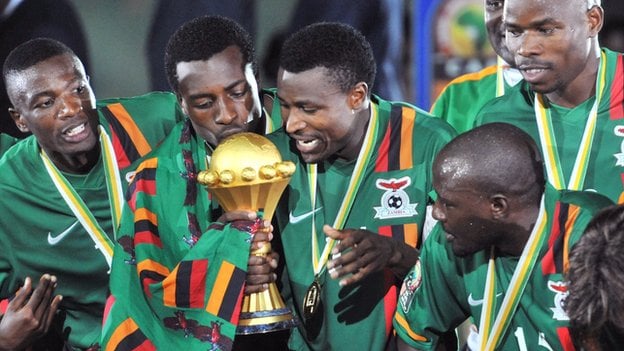
The Zambia national soccer team’s 2-1 loss to Ghana in the 2014 World Cup qualifier match is one of the most painful moments, especially for those who had placed so much hope in the team to progress. Having won the 2012 edition of the Africa Cup the team's reputation had skyrocketed making fans ignore the reality on the ground. Signs were all over the wall about our team’s ability or inability to compete at the highest level.
This is the team that
had just won the Africa Cup last year but failed terribly to defend the trophy
early this year in a tournament played in South Africa. They drew all their
three matches and three points wasn’t enough for them to qualify to the second
round leaving Nigeria and Ethiopia making it to the quarter finals from our
group. The truth of the matter is that the Chipolopolo Boys have not been
scoring goals and yet we decided to ignore this fact. That has been a major problem.
It is goals that win matches and not entertaining fans in as much as it is
important to make fans happy.
The task in Ghana
became more daunting because of the team’s failure to win matches that they
would have won. Here I am talking about the one all draw against Lesotho away and
the same score line with Sudan at home. The team had also lost to Sudan in their
opening match 2-0 only for FIFA to award them three points and three goals
after their opponents had fielded an ineligible player. Saifi Ali should not
have played after accumulating two yellow cards in previous matches.
That aside, what
happened in Kumasi follows a similar pattern of past results when the team came
so close to qualifying for the World Cup. We read about the 1973 team that was drawn
against Morocco and Zaire for the single place in the 1974 edition of the world’s
greatest football showpiece. Zaire qualified for the World Cup in Germany at
the expense of the Atlas Lions and the KK 11 as the Zambian team was known
then. What about the 1989 qualifiers after the team’s excellent outing in the
1988 Seoul Olympics? Everybody thought this was the strongest side to go past
Morocco, Tunisia and Zaire and home wins over the three opponents put the team
in a strong position only to lose 1-0 to both Tunisia and Zaire away and
dashing all hopes. Fresh in the memories of many fans and soccer pundits is the
drama of 1993, when after the Gabon air crash, the team was only a few minutes
away from US 1994 World Cup but Morocco scored the only goal of the match to
deny us a place.
What we do between now
and 2018 may determine whether the Zambia national soccer team will make it to
the next World Cup or not. There has been so much money being splashed around in
the name of supporting the team, hiring buses, planes and getting supporters to
the football venues. This kind of expenditure can’t bring glory to Zambia. This
money if it is directed to developing talent and organize our league can help
our team become competitive in Africa and the world as a whole. At the moment
there is no proper progression from young age to the senior level. When was the
last time that Zambia qualified to either the Africa under 17 or 20 age group tournaments?
For the under 20, it was in 2007 and it is where we had the likes of Emmanuel
Mayuka, Rodger Kola and Fwayo Tembo coming through to even play in the national
team and secure contracts abroad. That is the way to go and that is good
investment that can bring results. If we start now recruiting players who are 13
or 15 years old, they will be 22 years by 2018. It is a painful but worthwhile
route to take if you want to reap the rewards in future.
At the moment there
are no proper structures at local football teams and even at national level. Our
focus is and has been so much on immediate results. Another route that we may
need to consider is to lure those players in the diaspora, like the three children
of Charles Musonda who are playing at Chelsea in England and others elsewhere
as long as long as they have the Zambian roots. This is what strong teams like
Ivory Coast and Senegal have done. They made sure that they brought back all
their players who were playing in France and other teams in Europe to
strengthen their teams. Cape Verde and Gabon are the latest teams to have searched
around for their talents in Europe and bring them home. These boys abroad are
exposed to good training facilities at the young age and train with experienced
coaches who are helping them to be good and competitive players.


