Monday, 9 September 2013

Which way for Zambia national team?


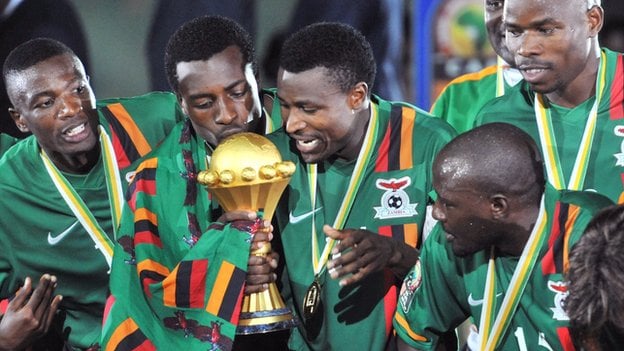
The Zambia national soccer team’s 2-1 loss to Ghana in the 2014 World Cup qualifier match is one of the most painful moments, especially for those who had placed so much hope in the team to progress. Having won the 2012 edition of the Africa Cup the team's reputation had skyrocketed making fans ignore the reality on the ground. Signs were all over the wall about our team’s ability or inability to compete at the highest level.
 
This is the team that had just won the Africa Cup last year but failed terribly to defend the trophy early this year in a tournament played in South Africa. They drew all their three matches and three points wasn’t enough for them to qualify to the second round leaving Nigeria and Ethiopia making it to the quarter finals from our group. The truth of the matter is that the Chipolopolo Boys have not been scoring goals and yet we decided to ignore this fact. That has been a major problem. It is goals that win matches and not entertaining fans in as much as it is important to make fans happy. 

The task in Ghana became more daunting because of the team’s failure to win matches that they would have won. Here I am talking about the one all draw against Lesotho away and the same score line with Sudan at home. The team had also lost to Sudan in their opening match 2-0 only for FIFA to award them three points and three goals after their opponents had fielded an ineligible player. Saifi Ali should not have played after accumulating two yellow cards in previous matches.

That aside, what happened in Kumasi follows a similar pattern of past results when the team came so close to qualifying for the World Cup. We read about the 1973 team that was drawn against Morocco and Zaire for the single place in the 1974 edition of the world’s greatest football showpiece. Zaire qualified for the World Cup in Germany at the expense of the Atlas Lions and the KK 11 as the Zambian team was known then. What about the 1989 qualifiers after the team’s excellent outing in the 1988 Seoul Olympics? Everybody thought this was the strongest side to go past Morocco, Tunisia and Zaire and home wins over the three opponents put the team in a strong position only to lose 1-0 to both Tunisia and Zaire away and dashing all hopes. Fresh in the memories of many fans and soccer pundits is the drama of 1993, when after the Gabon air crash, the team was only a few minutes away from US 1994 World Cup but Morocco scored the only goal of the match to deny us a place.  
       
What we do between now and 2018 may determine whether the Zambia national soccer team will make it to the next World Cup or not. There has been so much money being splashed around in the name of supporting the team, hiring buses, planes and getting supporters to the football venues. This kind of expenditure can’t bring glory to Zambia. This money if it is directed to developing talent and organize our league can help our team become competitive in Africa and the world as a whole. At the moment there is no proper progression from young age to the senior level. When was the last time that Zambia qualified to either the Africa under 17 or 20 age group tournaments? For the under 20, it was in 2007 and it is where we had the likes of Emmanuel Mayuka, Rodger Kola and Fwayo Tembo coming through to even play in the national team and secure contracts abroad. That is the way to go and that is good investment that can bring results. If we start now recruiting players who are 13 or 15 years old, they will be 22 years by 2018. It is a painful but worthwhile route to take if you want to reap the rewards in future. 

At the moment there are no proper structures at local football teams and even at national level. Our focus is and has been so much on immediate results. Another route that we may need to consider is to lure those players in the diaspora, like the three children of Charles Musonda who are playing at Chelsea in England and others elsewhere as long as long as they have the Zambian roots. This is what strong teams like Ivory Coast and Senegal have done. They made sure that they brought back all their players who were playing in France and other teams in Europe to strengthen their teams. Cape Verde and Gabon are the latest teams to have searched around for their talents in Europe and bring them home. These boys abroad are exposed to good training facilities at the young age and train with experienced coaches who are helping them to be good and competitive players.   
 

Thursday, 5 September 2013

A do or die match for Zambia


The permutations for the Ghana Vs Zambia game are very simple. Ghana needs a draw to qualify to the last round of the Brazil 2014 qualifier while Zambia requires maximum points to progress. That said the stage is set for Kumasi, some 500 kilometres away from the capital Accra and the reasons for taking this match there is because Ghana has been winning whenever they play there. In fact, the place itself has been dubbed the capital of football.

The Black Stars as the Ghanaian national soccer team is known have called all the key players for this match including those who had retired. Here I am talking about Chelsea’s Michael Essien whose last game for his country was in September 2011, Kevin Prince Boateng, the player who surprised many by moving away from Italy’s AC Milan to join Schalke in Germany and Andre Ayew, a player who stars for the French league one side Olympique Masseille. The Ghana team also boasts of young and exciting players in the likes of Christian Atsu who has just signed a five contract with Chelsea from FC Porto in Portugal and Assamoah Gyan who on a good day can be a thorn in the defence of any team. The inclusion of the three key players mentioned above underlines the seriousness with which the Black Stars are taking this match against the Chipolopolo Boys of Zambia. The danger though is that these players might cause some disturbances in the Ghana setup. This might also cause acrimony in the team especially if the regular players find themselves on bench. You look at yourself I have been with the team through thin and thick and then someone who was not there comes to take my place. This is the feeling going through some players.

Zambia goes into this encounter as underdogs when you compare the kind of talent on display for the Ghanaian team. This match itself is the main focus of the weekend’s qualifiers. The reasons for this are very simple. The two teams have an exciting set of players who play similar type of entertaining football. It is a match that everyone is talking about. The Ghanaians have every reason to respect the Zambian team that has beaten them in two key recent matches. The Chipolopolo Boys knocked out the Black Stars from the semi finals of the 2012 Africa Cup when the former beat the later 1-0. In the more recent encounter played at Levy Mwanawasa Stadium in Ndola, Zambia defeated Ghana by 1-0. When you look at these recent results, the Ghanaians have every reason to fear Zambia.

That aside, the match in Kumasi is likely to remain in the memory of many fans because Zambia is capable of upsetting the tables and make it to the last round of the World Cup qualifier. I did talk about some of the Ghana players but I didn’t mention any of the Zambian players. Let me do so. Zambia is going to be missing two key strikers, Collins Mbesuma of Orlando Pirates and FC Utrecht’s Jacob Mulenga, both are nursing injuries. This then means that the task of getting the much needed goals falls on the shoulders of Emmanuel Mayuka who moved on loan to a French team, new call up Rodger Kola and Fwayo Tembo. The midfield genius Rainford Kalaba of TP Mazembe who is slowly getting back to his old good form, Chisamba Lungu and Mukuka Mulenga can cause serious problems to the Ghana team. There is room also for skipper Christopher Katongo in the midfield to add the much needed stability in the team. The defence led by Stoppila Sunzu and Hichani Himonde is good enough to stop any threat from the Ghana strike force and Kennedy Mweene provides some experience needed for this match.

I did not want to waste much time talking about the intimidation that has preceded this encounter because I know football is played on the pitch and not in the board rooms. I wish to state though that there was no need for the team to come back for the prayers which they even missed. They could have connected to Ghana directly from South Africa where they were camping. The other confusion about the chartered plane being denied permission to land in Accra is just a symptom of the last minute arrangements on the part of the organisers. This could have been sorted out a very long time ago rather than on the day of departure. Let us not blame Ghana for this. What we should know is that emotions are normally very high for such encounters and tend to spill over.

Finally, I would say let the best team win but being a Zambian I would be much happier if we can beat Ghana at their own backyard. As you know football is a game which can sometimes produce shock results. Let us forget about all that has happened before this match and think about the game. I hope you will all enjoy the game. 

https://www.facebook.com/charles1mafa

Monday, 2 September 2013

Medardo Cardinal Mazombwe dies at 81


We all know that some day we are destined to die. Yet when the cold hand of death visits us, the shock in us all is palpable. I can’t help but provide some reflections on the death of Zambia’s first indigenous Cardinal, Medardo Joseph Mazombwe. The country has been robbed of a much loved son of the land, the man who preached the word of God to all of us and stood for justice. 

I want to take you back to 2010 when in the company of other Zambians, I travelled to the Vatican in Rome, Italy to witness his creation as Cardinal - a historic occasion for the Church in Zambia. It was such a wonderful and memorable experience to witness the events through the lens and provide updates for the nation.

It was on 20th November, 2010 on that chilly Italian morning that Emeritus Archbishop Medardo Mazombwe joined 24 others to be created cardinal by then Holy Father, Pope Benedict the sixteenth during the Public Consistory. The occasion was a colourful one and was repeatedly spiced by dance, ululations and cheers, mostly from the African travelling delegation. As he stepped forward and knelt before the Pope to receive his red hat, several Zambians who had travelled applauded him and ululated. It was a great moment to witness one of their own become one of the Princesses of the Church as Cardinals are sometimes called. I watched through the lens and was enthused to capture the images on camera in the majestic and iconic St. Peter’s Basilica. Soon after the Consistory, I stepped forward to congratulate him and receive a blessing.  I felt this excitement inside me like never before. It was such a privilege to be one of the first few Zambians to receive such a gesture from the new Cardinal. 

The following day I was to return in that same Church for the Holy Mass on Sunday, a continuation of the ceremony for creating the Cardinals. As usual the Church was full to capacity and many people were beaming with excitement in anticipation of the Mass that was to be presided over by Pope Benedict the sixteenth. On this day, Medardo Cardinal Mazombwe and 24 others were consigned with a ring. The ring is a sign of the bond that exists between the cardinal and the Church. In his usual soft voice, the Holy Father called upon the Christians to pray for the new Cardinals.

“I invite you to pray for the new Cardinals, asking for the special intercession of the Most Holy Mother of God, so that they may exercise their ministry in the Church fruitfully. As the new Cardinals accept the burden of this office, I am confident that they will be supported by your constant prayers and your cooperation in their efforts to build up the Body of Christ in unity, holiness and peace.” 

There were other events too lined up while in Rome. Soon after the Consistory, the Pope had an audience with the new Cardinals, their family members and all the faithful who had come to Rome for the Consistory. During this occasion held on Monday, the Pope delivered a discourse in several languages greeting thousands of enthused pilgrims from around the globe. In English, he said: “I extend a cordial greeting to the English-speaking prelates whom I had the joy of raising to the dignity of Cardinal in last Saturday’s Consistory. I also welcome their family members and friends, and all the faithful who have accompanied them to Rome.”

This welcome from the head of the Catholic Church gave me a sense of belonging to the universal Church. I felt very much a family member of the more than 2 billion Catholics.
During a thanksgiving Mass organized by Zambians based in Rome, Medardo Cardinal Mazombwe called upon leaders to promote justice, love and unity.

“And those of Us who are called into power and leadership, let us remember that justice is love. Where there is no justice, it is a proof that there is no love. The kingdom of Christ is the kingdom of justice, love and peace. The world nowadays is in crisis with regard to justice, there is so much injustice around us,” he said. 

When I spoke to Fr. Moses Haamungole, a Catholic priest who was at the time studying in Belgium, he described Cardinal Mazombwe as a great son of Zambia who contributed to the debt cancellation for Zambia. Fr. Haamungole who was in Rome for the Consistory further said the appointment of Cardinal Mazombwe “confirms the maturity of the Catholic Church in Zambia.”

“I am very happy the Church has recognized his contribution… and I think he still has an important role to play in the Church in Zambia. He (Cardinal Mazombwe) is one of the advisors of the Pope, so in many ways he will be called upon to give his input in the affairs of the Church,” he said.

Cardinals occupy a very important position in the Church. The College of Cardinals is responsible for electing a new Pope whenever there is a vacancy in the papal office and advising him on matters of greater importance. It is also from among the Cardinals that a new pope is elected. Despite holding such an influential position in the Church, Medardo Cardinal Mazombwe did not have a house of his own but chose to live in the parish of St. Francis De Sales in Thornpark, Lusaka. This sums up anything that has been or can be said about this man – a humble and committed servant of the Lord. 
   
According to a statement from the Catholic Archdiocese of Lusaka and the Zambia Episcopal Conference (ZEC), His Eminence Medardo CARDINAL Joseph Mazombwe, the Archbishop Emeritus of Lusaka Archdiocese passed away in Lusaka’s University Teaching Hospital (UTH) on Thursday, 29 August 2013 at around 17.40 hours Zambian time. 

Brief PROFILE of Medardo CARDINAL Joseph Mazombwe as compiled by ZEC
Zambia‘s first indigenous Cardinal

Cardinal Mazombwe was born on 24 September 1931 at Katete in the Eastern Province of Zambia. He was ordained a Catholic priest on 4 September 1960 and became Bishop of Chipata Diocese on 7 Feb 1971.  Between 1996 and 2006, he was the Archbishop of Lusaka until his retirement in 2006.

On 30 November 2010 the then Holy Father, Pope Benedict XVI created the Emeritus Archbishop of Lusaka, Medardo Joseph Mazombwe, as Zambia’s first indigenous Cardinal, at a public consistory held in St. Peter’s Basilica, at the Vatican. 

Cardinal Mazombwe has held several senior positions in the local and regional Church, such as Zambia Episcopal President (1972 – 1975; 1988 – 1990 and 1999 – 2002); and as Chairman of the regional conferences of the Association of Member Episcopal Conferences in Eastern Africa (A.M.E.C.E.A.) (1979 – 1986).

In the months leading to the year 2000, Cardinal Mazombwe, as Archbishop of Lusaka, was an ardent campaigner for the cancellation of Zambia’s international debt, in the Jubilee 2000 movement. Most visible among some of his numerous pastoral initiatives, is the sprawling Cathedral of the Child Jesus (Pope Square) in Lusaka.

Cardinal Mazombwe’s optimism and courage in the face of Cancer inspired many that visited him in the last twelve months. Even as he grew weak, Cardinal Mazombwe never gave up his passion for the affairs of the Church and the nation.

MHSRIP